Hurricane hardened Havana

Image result for havana airport

Hurricane Mathew’s recent Cuban rampage made me think back to February 2009, when I visited in the wake of hurricane’s Ike and Gustav.

I had just finished a TEFL course and Googled, ‘volunteering’. ‘Three weeks teaching English in Havana’ came up. I pictured creaky pianos on dusty verandas and old Cadillacs wheezing on shampoo. I was curious to see if the clichés were true, see what was really left.

The location was central Havana, I didn’t need to drive, and I could use my new TEFL skills – no former experience required…

The arrivals conveyor belt was empty and still. Our luggage hadn’t been stolen. It had been hidden. In corners, behind doors, in bins. I found my plastic-wrapped suitcase, conveniently just outside the women’s toilets. It was shaken up, but intact.

The airport staff, bored out of their lively Cuban brains after 5 years of seemingly futile university education, had given we tourist-voyeurs our first taste of Cuban wit.

I am met by my tour guide and find we are taking an exclusive ‘taxi’ that looks like someone’s car, driven by her friend. Not an old Cadillac but the new shiny fruit of last season’s tourist dividend. We arrive at an expensive hotel and make our way to the cool basement whose menu could have been from anywhere in America – hot dogs, hamburgers, chips, ice-cream sodas, club sandwiches, etc. She orders profusely and eats ravenously.

It’s the very beginning of the tourist season and, like many, she’s still haunted by low-season austerity.  I pay for us both, on her recommendation. I would have offered first, had I not been confused by her smart manicured appearance, had I realised where I was – in Cuba, with a Cuban. For any time spent, I felt I was expected to tip, as I would a waiter, for a tasty plate of conversation. It’s not that they didn’t enjoy the exchange, but that’s what it is, an exchange –  Cubans need food and loo-roll and crave treats like a glass of beer once a month, something that the state never supplies, and their wage of £30 a month cannot buy.

The next morning. My first day. My hotel was a high rise 90s eyesore, complete with dusty fake ferns. My room was on the top floor, had cold running water, a fridge that worked well as a tepid storage cupboard and a bird’s eye view across city and sea.

I drank in the hurricane-blistered rooftops, windowless apartment blocks and the seawall called ‘The Malecon’. It draws a grey line between Havana and the rest of the world, curving slightly against every passing wave. At its midpoint, the ‘Hotel Nacional de Cuba’ stands out with the loud confidence of New York in the late 20s, once mafia HQ. Florida might even be visible now from the top suite…

Image result for Hotel Nacional de Cuba, Meyer lansky

So, down to my dusty  fern-decked  hotel lobby. I was late. The group was already sitting comfortably. I was the only non-Canadian, the youngest by at least 40 years and the only one, it seemed, not to have retired from head-teaching at a renowned education institution. No doubt my fellow volunteers had all been a punctual 5 to 20 minutes early. Had I missed something on the website? I was obviously not its target group. Anyhow, the Canadian-Cuban company I’d paid had welcomed my sterling with open arms and here I was, with everyone smiling at me with that ‘can do’ magnanimity particular to philanthropic Canadians on volunteering ‘vacation’ in Cuba.

In my mornings I taught at the university. As the sole Brit on the trip, it had been deemed apt for me to take the Anglo Saxon history class, on my own. There was only one book, one physical book, for the class of 60. I knew no more about Anglo Saxon history than that King’s names often ended in ‘red’ and had vague memories of Alfred, whom I confused with King Arthur and the Knights of the round table.  Needless to say the Cubans, as in all other physical and mental respects, gained the upper ground, quizzing me intensely on Anglo Saxon involvement in Byzantine trade routes. My responses were garbled and evasive. Requests for repetition were frequent, “It’s difficult to understand your German accent” they chorused in pitch-perfect Canadian. My Queen’s English was new to them, brought up on a constant maple-barked volunteer stream, with no access to the BBC. Anyhow, without me, books or broadband, it seemed they were managing to quite well.

After a particularly gruelling lecture, I found myself sitting on the steps outside the Law Faculty.  A student walked pointedly up to me and asked me if I was a student. I was shocked. I had been spoken to in Spanish. I had never been mistaken for anything other than a pasty Aryan, in Cuba, or anywhere else.  I said no, carefully. I said I was a teacher, unconvincingly.  I wondered if I had enough Spanish in the tank to carry me through this conversation sprint. I did.

Image result for university of Havana, steps

Soon after, we were in a cafe he claimed had been a favourite of the young Castro. We weren’t paralysed by choice: chicken with rice and or beans. These were delicacies craved by the children I taught in the afternoons. All had chimed “Rice and chicken” in joyous unison to my question “what’s your favourite food?” two mischief-makers daring to add “beans” to the decadence.

It occurred to me, looking around the cafe, opposite this Cuban aqua-physiotherapy student, that I was blending in and not because I was developing a mahoganous Caribbean tan.  My lunch companion was the only Cuban who wasn’t working behind the bar. Customers, as in most ‘Cuban’ bars I visited, were tourists – For Cubans a glass of beer once a month was a treat to be shared, once a month, maybe, between two.

He explained his frustration at being a student of aqua physio with no real access to still water, the pool they practiced in was dry.  I thought of my hotel pool, cracked and economical with chlorine, but full nonetheless. Seemed Havana had two faces, one for me and one for him. After lunch he bid me goodbye politely and returned to his empty pool on a full stomach, hunger abated for another day. I felt regret, perhaps naively, that I had no spare things or money to give him and wondered what he needed.

I later looked back and thought how nice it was that we had managed to have a meal without bartering. My later experiences taught me that everything I was wearing or carrying, down to my bra’s underwire, was on the market, to the highest bidder, and the currency is banter. The sweetest talkers are the best dressed – they can be your best friend in 5 minutes, in any one of the world’s top 5 languages.

One afternoon we had a tour of the university from the head of the law faculty, who carefully stuck to architectural did you knows about the faculty’s buildings and mentioned he had been a translator for Jimmy carter, but was careful not to elucidate. He finished his tour with a plea for toothpaste and loo-roll, he said, since the hurricane, his wife and he struggled for the bare essentials. We were all apologetic that we hadn’t thought to bring any out with us. Some of the Canadians, indeed, studied veterans of former trips, had brought these with them in extra suitcases and distributed them as and when they could.

The next week we visited a hospital where we were told that Venezuelans came to learn to be doctors in exchange for oil. It was like a garden centre, with large glass roofed plants, sourced from all over South America. Cuban scientists are leading the way, our guide informs us, with pioneering research into local sourcing and cheap production of herbal cures and preventions, circumventing costly imports of patented drugs and vaccines.  It sounded utopian, evocative of Huxley’s “The Island” –  One morning, I stumbled into a square with a troop of octogenarian chicas practicing Tai Chi. In my best, newly acquired Canadian-Cubano confidence, I asked, ‘Where are the men?’, ‘Not dead, just lazy” one called out cheerfully, mid flying-crane.

The last morning, my last afternoon in the school. The electricity was off, again. The children’s planned performance ‘to music’, their parting thanks for our teaching, was now a little tricky. Without hiatus, however, their collective Cuban brain shortcut resourcefully to a percussive solution.

Pencils and chair legs doubled as drum sticks. Table, wall and floor morphed into drums. Stamp, click, stamp, click, cluck the tongue, snap the finger. Repeat. All while curling spines and swinging tiny hips. Those who weren’t busy being the band paired up: chiquitos with chiquitas, and moved their toes in sync, like professional, post-pubescent pros. In the audience their parents swayed their approval, in perfect time, smiling with the relaxed futile pride unique to Cubans.

These ‘street’ children were as academic as they were physically adept. Their English already very good, aged 7, they were writing in cursive script that puts Oxbridge graduates to shame. Indeed, between their Cuban teachers and Canadian volunteers, someone was getting something right. As for me, they certainly didn’t need my help when it came to perfecting their Canadian accents or indeed, lifestyle tips. Fuelled by innate rhythm and, arguably, austerity, these children and their, seem happier and healthier than I’d thought possible.

I got the sense that Havana was a party that keeps dancing, challenging the band to play on and on and inviting whoever is listening, to join in, even though the taps have run dry and the night is over. Doubtless things have changed over the past decade. Cubans seem to act quickly with steps as ingenious and spontaneous as the music that fills Havana’s many cracks. Obama came in during the second of my three weeks and already the lightening mood and arrival of some newish looking furniture, suggested change had already begun to seep through. I wonder how resilient this change will be, in the wake of horrendous Mathew.

I have hope, however. Cubans are masters of survival, used to emptying everything and float lightly, like Hemmingway’s Old Man, only to fill up again, and see how much won’t sink them. I hope this resilience sees them through Matthew as it saw them through Ike, Gutav and their predecessors.

One day I would like to go back and mark changes, mourn Cadillacs. See if glassless window holes have been filled and shuttered and Cubans are unhappier or unhealthier, or if they still smile and sway their hips while queuing all afternoon for a single scoop of state-supplied ice-cream.
 

Venice has a mask for every face

In 60 years sea levels will have crept 8 more inches up the Doge’s already stumpy columns. In 60 years, I, on the verge of death, hope to take my zimmer for one last ride up San Marco’s bell-tower lift and survey Venice’s mysterious, sinking glory.

There is nothing wrong with Venice. The stalls teeming with tack only set in relief the sheer beauty of this cunning floating city, scene to so much stinking tilted wonder.

It’s impossible to get lost in Venice. Every track, if you ignore ambiguous signs to the Rialto and San Marco, leads to some new, somehow intended, discovery: a part of Venice meant just for you, at that particular moment.

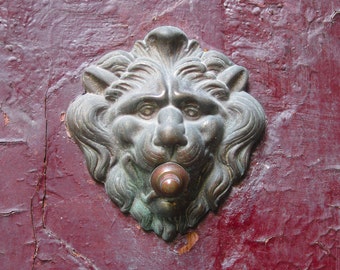
Lions  lead the way.  Immortalized in stone and bronze, they look down regally from the balconies or, guarding doors, gaze up watchfully. I feel intrusive, cruel and a little scared, as I push one of the many brass doorbells that is also a lion’s tongue.

Image result for Venice, lion doorbell

Having witnessed so much for so long, at such intimately close quarters, Venice and its lions have become somehow animate and wise. Whatever your mood, you feel it is sensed by more than the Venetian authorities’ liberal peppering of CCTV. The ancient canal-veined piazzas are like crafty Venetians, canny as they are charming – they play your mood up or down to suit their whim. You find that one piazza offers sweet antidotes, another plies irresistible corruption, the next lays you bare and leaves you pitifully exposed. And they swing from mood to mood. Today Santo Stefano is expansive, Campo Bandiera e Moro is vacant, San Marco is indecisive.  Tomorrow, the opposite may be true, depending on the light, the fog, your mood and theirs.

This is, I suppose, how we project our thoughts onto our environment at home, but Venice is a city of mirrors and the reflections are clearer, never quite what you expected. No two people or objects ever share the same view.

One day it will all be buried under the sea, like Atlantis.  Maybe a dozen lucky lions will be rescued and revived and speak of their masters.  Men who tricked geology and the waves for 3 millennia. Tricks of bricks and glass-flutes and chandelier-like masks, all continuously and elaborately confessed beside Tintorettos and Titians under precariously high belfries, with here and there a freshly minted icon, for luck and good measure.

I feel privileged to have seen Venice in all its weary decadence, before it puts on the final death mask. A place of constant magic. However old and jaded, it never tells the same story twice. Mother of the Commedia dell’ Arte, it too, is an unscripted drama. The light and sound and smell is forever switching, bringing out something new or secreted, in both itself and its audience. One moment it’s thick and clogging and fools you into thinking you can predict it; the next, it’s free and crisp and glistens anew with a brilliance that strikes fresh awe.

How I hope, beyond hope, that Venice somehow manages to carry on its magic tricks, recklessly ignoring the inevitable swell, facing sea, silt and pestilential swarms of selfie-sticks with its myriad of shimmering masks, grimacing and grinning into eternity!

Image result for commedia dell'arte, mask


Where to eat

Dinner/Lunch

Osteria “Al Covo” (interesting twists on traditional favourites – all locally sourced as part of the Italian slow food movement. Known for it’s amazing biodynamic wine list

http://ristorantealcovo.com/   Tel: +39.041.5223812 Castello 3968 Venezia

TAVERNA DEL CAMPIELLO REMER (Venetian classics and nice live jazz music in an old cellar)

SESTIERE CANNAREGIO 5701 Venezia

Osteria “Il Paradiso Perduto” (nice place for lunch – don’t be put off by the multiple translations of the menu for tourists, home-made parpadelle is top notch)

Cannaregio, Fondamenta della Misericordia, 2540 – 30100 Venezia

Gelato:

I’ve tried a lot and this was definitely the best (pistachio actually tastes of pistachio and not just green food-colouring) and in a nice, off the beaten track square, :

Gelateria del Doge  (http://gelateriaildoge.com) Dorsoduro 3058/A, Rio Terà Canal, 30123 Venezia


What makes a portrait great?  

Photographs capture a moment in time.  In exchange for the depth and truth of this one moment, photographs risk loosing the whole truth of all the other moments that have brought it to the viewer.

Saint-Exupéry, in  The Little Prince,  says ‘What is essential is not seen’.  A great portrait can be entirely abstract or ‘warts and all’; the final goal should never be  to get a visual likeness, but to take us to unseen dimensions, beyond the skin.

A bad portrait  can be replaced by a photograph. A great portrait layers experience over appearance, to conjure up something that’s part of time and yet beyond it.

Many of the portraits in this year’s exhibition pointed towards this extra dimension.

The National Portrait Gallery’s 2016 BP Portrait Award runs until September


Recommended reading

‘Diversion’ by Charlie Masson, oil on board, shown above

The Little Prince by Antoine Saint-Exupéry

The origin of the phrase ‘warts and all

Appetite for Travel

Yesterday’s  Travel Lab at Ogilvy was fantastic fuel for thought on the latest developments in user behaviour and what they mean for travel. Here’s what I got from it

The experience economy

We care less about stuff, we care more about experiences. We care less about what we have and don’t have but more about what we can do and what others are doing.

We are moving to a new form of materialism, a new form of consumerism. Status and vanity are now expressed and fed via shared experiences, rather than possessions. The recent surge in support for organic, fair-trade, free-range produce, for instance, is now mirrored by increasing demand for organic, fair-trade, free-range, and increasingly ‘freegan’ experiences.


Travel is the ultimate product

This experience economy, coupled with the sharing economy is presenting huge opportunities for the travel and entertainment industries, the first to see experience as product. Countries, and the travel brands that feed them, now serve as ‘manufacturers’ of the experience, subject to the same scrutiny and brand-opportunity as manufacturers – having to make the purchase-case, and do it in a way that suits the latest ‘experience’ consumption behaviours and expectations.


Experiences must be wearable

Now, when we ‘go on holiday’, we expect and want more than just a holiday, we see it as something that we can package up and use as a creative accessory, to express ourselves to our friends, family and the wider world.

Never, when we ‘go on holiday’ have we changed into another person. Since who we are is increasingly cloaked, if not yet fused, with technology, we like to and increasingly need to, take our technology with us, wherever we go (unless it’s a tech-detox retreat, which we’ll no doubt  inform our friends about and write Tripadvisor reviews on).

We need to be able to continue plugging in to the new experience in the same way we plug in to our daily-life (The Internet of Being)


Opportunities for the travel sector

Today’s speakers gave the view of the Jupiter-sized opportunity that the better start-ups spotted a while back. The most successful digital developments in travel seem to share the characteristic of successful ‘sustainable’ retail and food brands, feeding the experience appetite  with healthy, ethical options that are designed for public as well as private consumption.

If people feel that the experience they have is not only benefiting them, but also contributing to the greater good, they are more likely to buy and tell people they have bought  and, what’s more, making the effort to get others to buy that experience will make them feel good and that they have ‘done their bit’

‘The internet is creating a massive sampling campaign for other places’ (Rory) – helping us to find the best experience, that ‘people like us’ have liked.

The implications for this is the idea of countries as brands – There’s more involved in the decision now, not just the hotels and flight connections.  Like a potential partner on an online dating site or a pot of palm oil, we want to know if it’s right/healthy for the kids to meet/eat it… beyond AirBnB and Tripadvisor, lots of apps are capitalising on this ethical and cultural evaluation aspect (GreenHotel, YahooLabs, BackstreetAcademy, Fortaleza Tour, Lopeca, SideKix, Nectar & Pulse – instead of googling these individually, take a look at Springwise – a great forum, archive and search tool for all these types of thing and more)


My top five links from the day

  1. Visit Britain – choose Chinese name for a range of British landmarks…
  2. fly – travel memoir makes an elegant travel journal that draws on data from multiple apps to create an all-singling –all dancing record of the trip that can be circulated on/offline…
  3. Icelandair stoposver buddy service – for free, Iceland-air will team you up with a real Icelandic person who will give you a guided tour out of the icy goodness of their hearts…
  4. Fieldtrip to Mars – recognised with a Cannes gold, the biggest bravest attempt at virtual reality ever, Lockheed Martin took a school bus full of real school kids to Mars (not really, just kidding ;)) Hail the new competition for traditional travel – I think, as AirBnB was to hotels, so virtual travel and gaming will be to, well, real places..
  5. Ditch postcodes – use the 3 word addressing system –  everywhere you have ever been and want to go now has 3 words associated with it that you can find and share via phone. Whether you’ve lost your tent at Glastonbury, you’re phone-equipped tot strays in Disneyland, you’ve broken your foot in the Gobi, there’s now an app for that..

Written by women for all Mankind

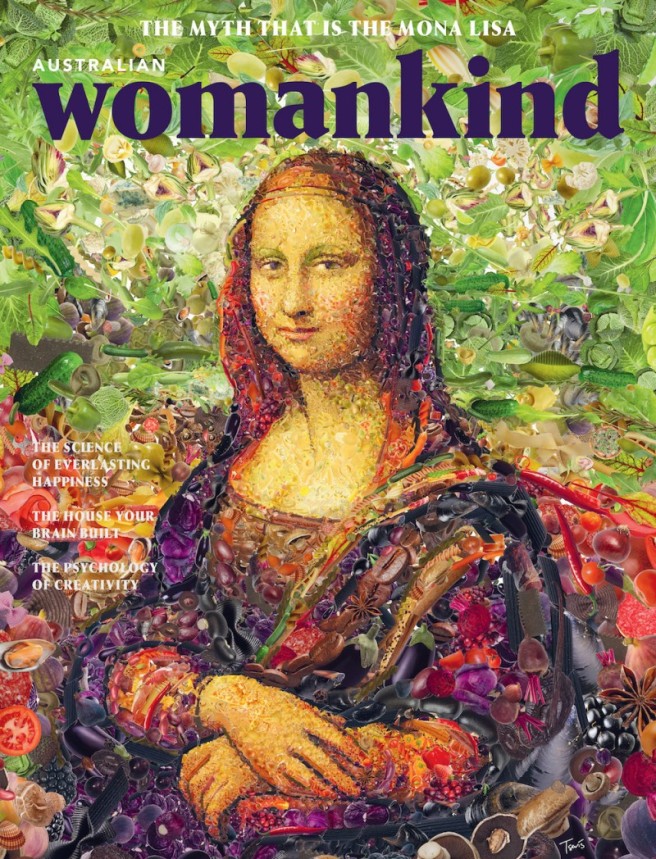
womankind6_small-cover-800x1048

Last Sunday I was about to get on the tube for 1.5 hours and needed something to read that wasn’t the news. Upton Park Newsagents had run out of all women’s mags except one. Womankind. A new magazine that is currently running it’s 5th issue.

Why the magazine should find itself here, in the home of West Ham football, amidst a sea of random, male – oriented periodicals is anyone’s guess.  It’s the only magazine  I’ve ever paid £5.99 for and don’t regret a single penny.  It kept my attention from cover to cover, every single page, and there are 129 of them, no ads.

It covers so much in such a consistently considered and beautifully laid out way.  Be you man or woman,  it’s choc full of mind-treats – from  the great art of the world, the opportunity to expand life beyond the daily grind, the latest on the workings of the brain and the pleasure taken in a nice picture of a bird with a bit of info you didn’t know and weren’t searching for but feel better and wiser for having absorbed…

womankindmag.com

To be or not to be a woman

Linda

Step aside Nicole. Although intended for Kim Cattrall, Penelope Skinner’s new play ‘Linda’ is no celebrity vehicle feebly driving a ready – made feminist message.

This is a play that gives you an idea of what it might have been like to watch a Greek tragedy as a Greek woman.

Here is the power and powerlessness of women writ large, “Changing the world one girl at a time” .The word woman is the elephant in the room. It’s dangerous, it could lead to depression or worse…

Why? The play explores what it is to be a woman, now, through the eyes of a typically dysfunctional modern family. The play’s 5 women/girls face all the new “millenial” challenges, front – loaded with the old.

It’s staged on bright and wrinkle – free sufaces that ingeniously rotate us around and through Linda, the career – driven mother’s shiny, mirror-strewn, self – made world.

Work and home sets ingeniously pry into and reflect off eachother and back at the audience, showing what all the play ‘ s 5 female cast feel –   The pressure to be, do and have everything, on display, with beauty as your foundation, funded by a far greater ad spend than “Truth”.

If ‘Linda’ means ‘the beautiful’, I’d love to task Penelope Skinner’s ingenious pen to write a sequel entitled ‘Vera’,  ‘the true’.

Catch Linda in her last week at London’s Royal Court Theatre.


A Christmas Tree for New Year

Hand Anderson

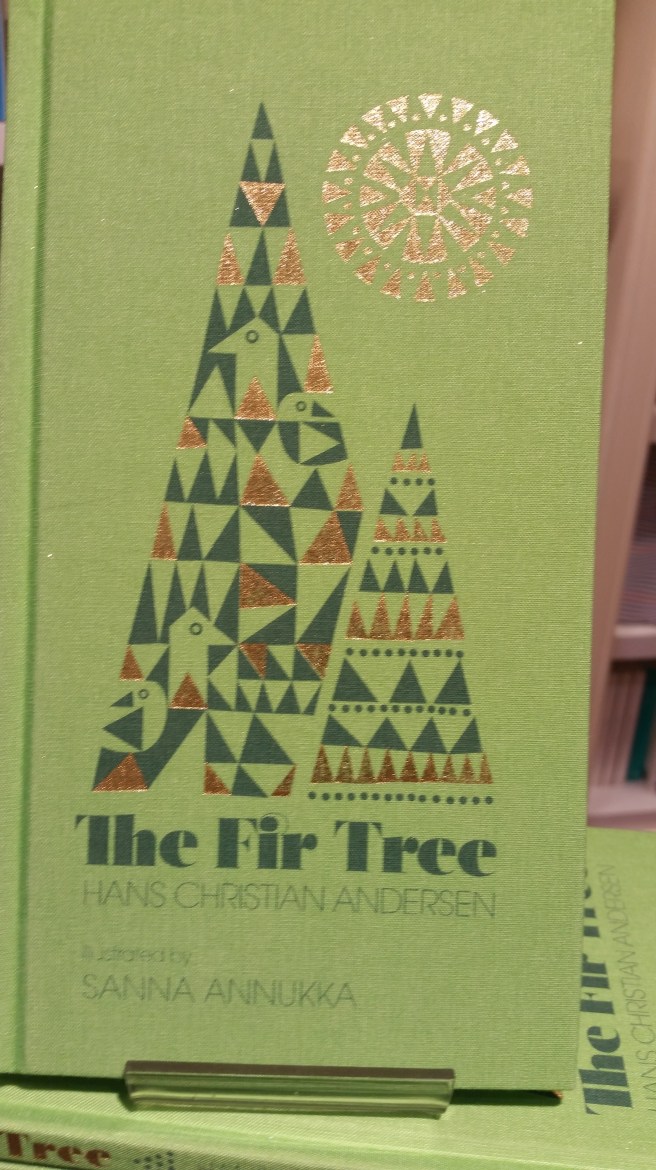
The Fir Tree is a fable of a Christmas tree that rues the day it took its roots and woodland home for granted. We should be happy, Hans preaches, with what we have, when we have it. Not just at Christmas.

The mice in the story help the tree reach this realisation, pointing out how luxurious the tree’s former life has been. The tree, like so many of us, was blessed and wasn’t thankful at the time and now regrets his inertia. Humankind, programmed to forget this simple oft repeated lesson, has evolved myth and fable as reminder- mechanisms designed to kick in when faced with another bout of

“I take joy for granted and am never satisfied with anything, especially myself”.

Anderson takes us beyond the tree’s traditional, simpler symbolism of festive reward. He uses the erring and ultimately redeemed tree to teach mindfulness and gratitude. The tree must die every year whereas we continue and must be forever thankful for our continuity through the seasons, however few or many.

Thus the tree acts as an offering and a reminder, both in the pagan and Christian rituals of death and sacrifice in exchange for new life and renewal. We fell a tree each year and adorn it each year to remind ourselves of our own luck and the abundance of life, growing us sweets and lights, year after year, with or without LED.


Read the fable online

Get the Sanna Annuka hardback edition


The British Museum is now the world’s private collection

Agnes Martin gave us space to think beyond everything we see, what’s left when civilization is removed, before we impose language and thought, ‘My paintings are not about what is seen. They are about what is known forever in the mind’.

Agnes Martin Press Call, Tate Modern 2.6.15

And so if Martin takes us outside time, provides the backdrop, the British Museum leads us through time, providing the props, wherever and whenever we want to set the play, the dressing room of civilization.

The museum’s objects play out, across vast distances and ostensibly disconnected cultures, our shared consciousness and show us humanity’s history. A history of diversity  and integration, overlaid with repeating, universal patterns, indicating that we are all united by the same underlying needs, truths and impulses, wherever we are, whatever our culture and religion.

At this time of earth-shaking social friction and division, whether or not we, as autonomous individuals, understand and respect the universal nature of humanity is now a matter of life and death.

Cue for the British Museum to open its curtains and show the world the world – how no one race or culture is without connection to another and how every dominant race or culture eventually recedes.

In answer to accusations of colonialist hoarding piracy, the British Museum is now entirely open to everyone. Via its new online gallery tour, anyone can see everything that real visitors can see. Be you a shepherd in Afghanistan, a Greek in Athens, an Aborigine in Australia, a skater in LA……If you have a screen and broadband that is…

In its own words:

“The more we can work with partners in the technology sphere, and the more we rise to the challenge of making our world a digital one, the greater will be our impact on community cohesion and understanding, domestically and internationally. Through technology, the Museum’s collection can become the private collection of the entire world. And so our great Enlightenment vision moves into a phase our founders in the 18th century couldn’t even have dreamed of.”

Read the museum’s blog article introducing the online gallery.

Egyptian dwarf god Bes,
Egyptian dwarf god Bes, protector of the family , childbirth and sexuality. 100 BC/AD. British Museum


The ups and downs of Asperger’s syndrome

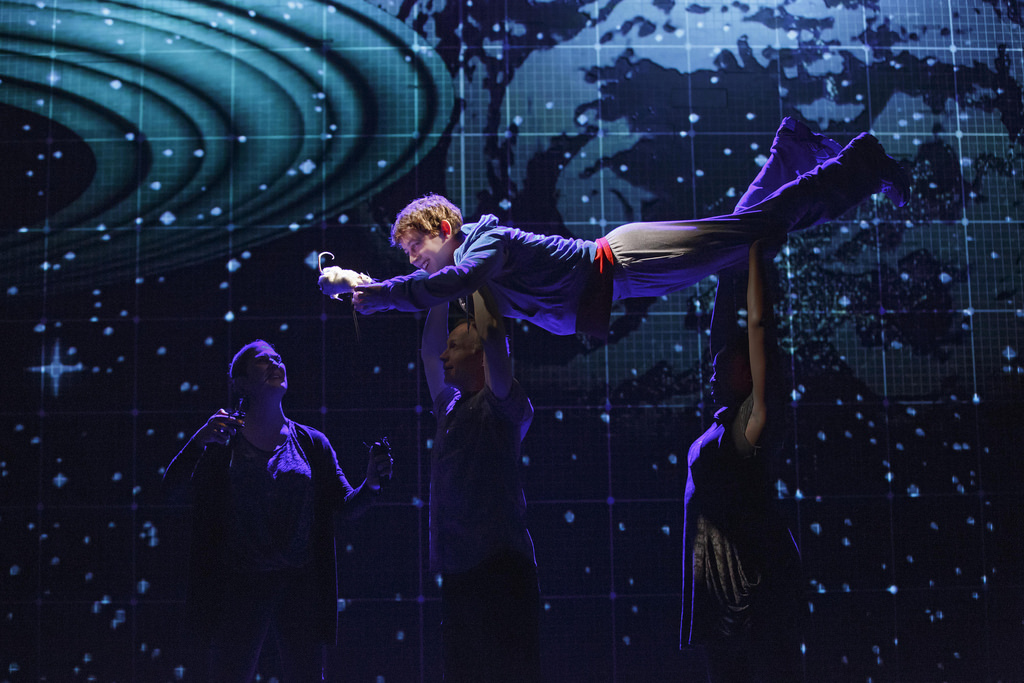
Curious Incident of the Dog in the Night-Time

Came out of this play feeling thankful that I could walk to Piccadilly without panic. The street-signs and lights were all in a harmless position, tucked into the bricks or resting on poles, and at least two foot away: a safe distance. A couple jostled past. A man’s hand hit mine. It hurt but it didn’t shake my inner being.

Thanks to ACIOTDITN, I am consciously grateful for my functioning limbic, parietal, and other regions that I can’t recall because I lack the total recall ‘malfunction’.  We, the audience, were let into what the majority are locked out of, given a brief peer into someone else’s box.  The box labelled ‘Asperger’, peculiar to us and particular to the 15 year old Christopher, is shown to contain a rare species of sense different from the common, that’s often more logical, and no less real. It’s perhaps closer to Nature than we give it or Nature credit for. Christopher sees everything that is and all that that entails; things and ways that we, in our own shared blindness, blank out in favour of a filtered self-created version that plays on repeat…

Those whose brains have a different mode for rendering reality can wake us up to the deception of perception. They show us we are walking through a carefully constructed creation of which we are largely the inventor. The film Inception, flawed though its concept may be on many levels, springs to mind. Since we all have access to the same ingredients and use the same tried and tested recipes, we have the delusion that there is only one way. This shared delusion dupes us into thinking that the cake on the table, with red jam and white cream and beige sponge is undoubtedly a cake on the table and has, in actual fact, those exact characteristics, in the real world, a world of real cake.

This play and book show us that there are other ways of constructing ‘reality’.

By leading us through Christopher’s labyrinthine mind, they make us think. They indicate the scale of the ‘inconvenient truth’ that most of us switch off. Christopher is permanently switched on. Like a wild animal not used to ‘civilised’ inertia, afraid to be touched, noticing everything, absorbing all the creation around him, he very quickly reaches saturation point. Electrified, he has a fit because he has trouble finding the off switch, feeling the universe’s constancy beam around him, all the time.

Obviously, this is highly inconvenient, at best, and crippling, even fatal, at worst. But there are lessons to be learned on both sides. Maths is the compass he uses for navigating through a world with the burden of total attention. Everyone knows that maths’ principle ingredient is truth. ‘Normal’ people can use maths to meet him in the middle. Maths can help ‘normals’ as it helps Christopher – help us navigate the shanty town we have built outside reality. Wherever our attention and perception stray, individually or collectively, maths will always lead us back.

After the ‘final’ curtain draw, the curtains re-open to reveal the answer  to our teenage hero’s  final maths A-Level exam question  – it’s about Pythagoras’ right-angled triangle and proving how and why it’s right-angled (or something.. – I’m as bad at maths as Christopher is at telling lies). The answer emerges like a celestial truth, drawn in chalk on the night sky of the stage back-drop. The equation was solved. It was true. I was somehow reassured and deeply moved.

Try as we like to draw ‘real’ lines through existence, between fantasy and reality, some things are fundamental, like maths, or faith.

The Curious Incident of the Dog in the Night-Time is based on Mark Haddon’s award-winning novel, adapted by Simon Stephens and directed by Marianne Elliott. The production won 7 Olivier Awards including Best Play in 2013 and is currently on tour in the UK.

A weekend with Agnes Martin

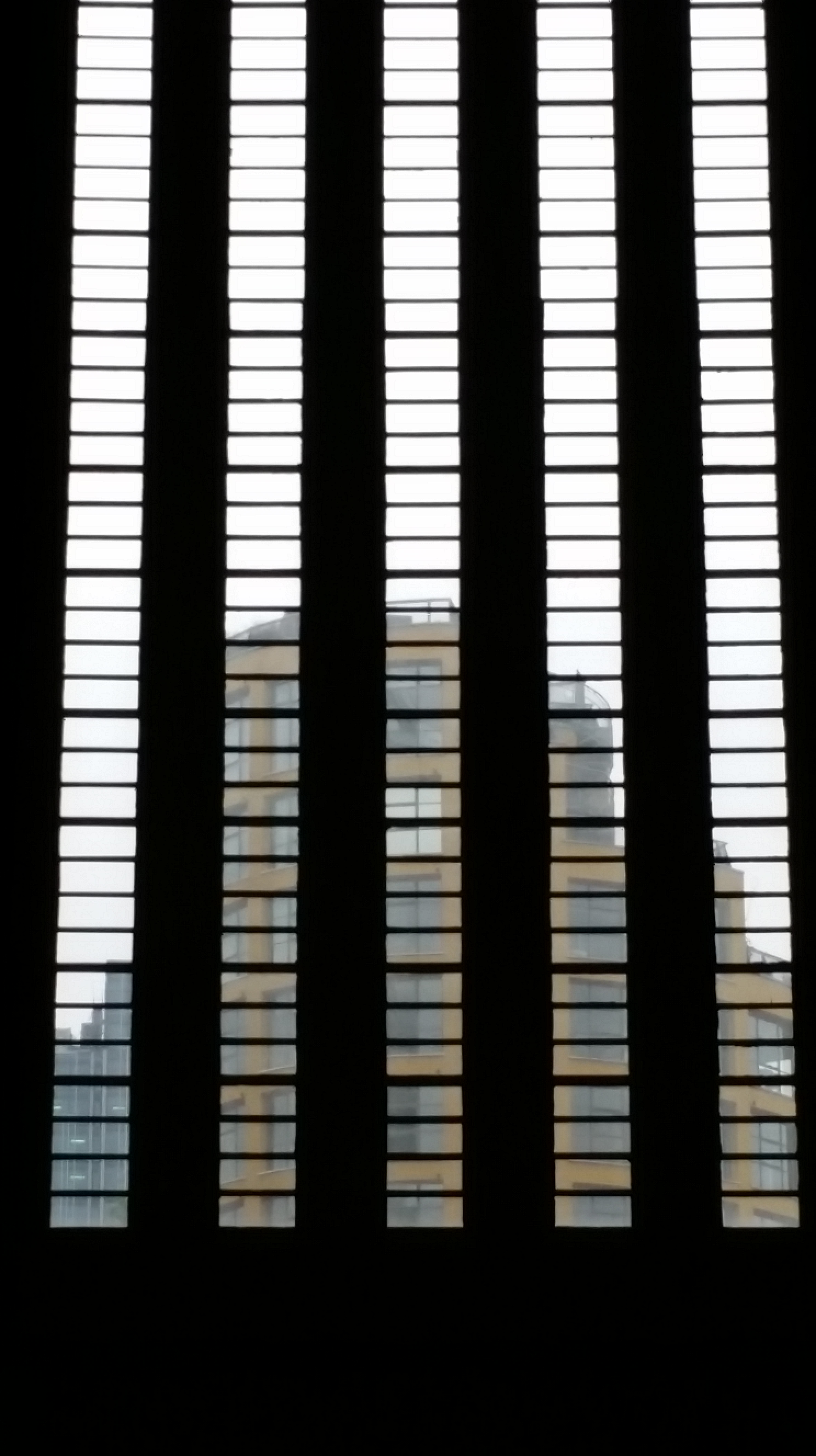
Pic of the window to the Turbine Hall, Tate Moders, London
The window to the Turbine Hall, Tate Modern, reminds me of an Agnes Martin

As I stood in front of her works in her recent exhibition at the Tate I thought:

The Stars were and are like that, somehow. The Sea and Gratitude are like that, precisely, point for point and line for line. Here is a genius that transcends all previous attempts to capture beauty through art. She understands that beauty and nature cannot be trapped, nor can the complexity of their underlying symmetry be seen or understood. She shortcuts, with immeasurable generosity, to the harmony and ecstasy that can only be experienced through complete negation – shapes, curves, colours are all byproducts of the truth. Truth is infinitely simple and, being true, it is infinite.

4729034650_7bca12ca36

It is the function of the artist to evoke the experience of surprised recognition: to show the viewer what he knows but does not know that he knows. (William Burroughs)

Portrait of the artist sitting infront of her picture
‘My paintings are not about what is seen. They are about what is known forever in the mind.’